Publications
Inverse Design of Metainterfaces for Static Friction Control: Beyond the Hertzian Limit (2026)
arXiv, 2605.11012
Abstract: Programming the static friction of mechanical interfaces is critical for soft robotics, haptics, and precision gripping. Static friction is governed by the real contact area, and standard rough surfaces exhibit a linear area-load scaling inherent to classical Archard and Greenwood-Williamson models, severely restricting their functional range. Here, we propose a framework for the inverse design of tribological metainterfaces engineered for programmable contact behaviors. By utilizing general axisymmetric asperities, we unlock nonlinear macroscopic responses unattainable by standard Hertzian contacts. To solve the inverse problem, we embed a fully differentiable contact mechanics engine within a neural network … [shortened for brevity]
| Paper PDF | Code |
Mapping the limits of equilibrium in sheared granular liquid crystals (2026)
arXiv, 2603.25252
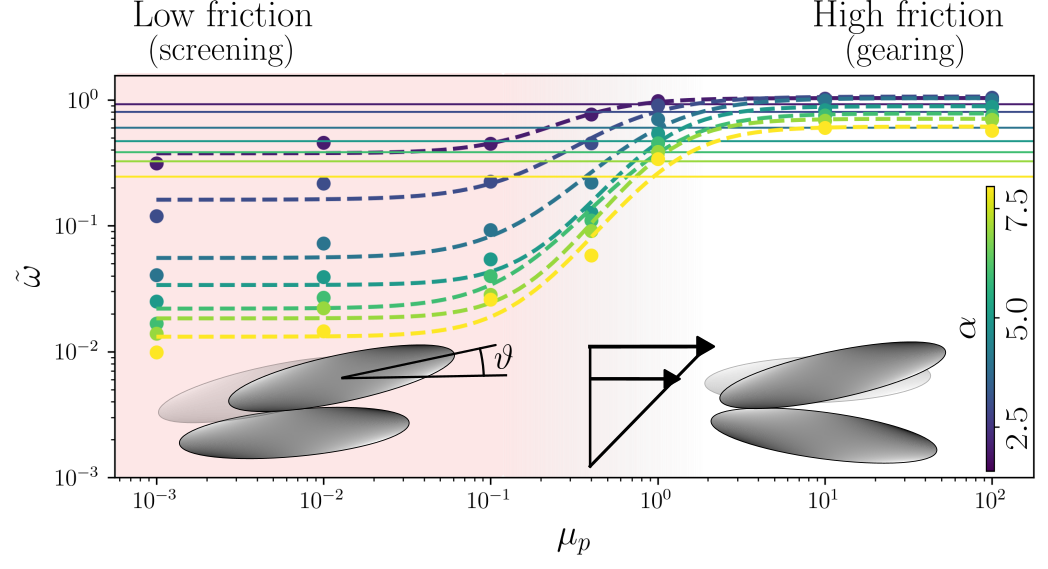
Abstract: Athermal elongated particles are well-known to follow Jeffery orbits when sheared in viscous fluids. It is less clear if similar orbits appear in dense granular flows. We show that when sheared for long enough, sufficiently elongated frictionless granular rods, rather than following noisy Jeffery-like orbits, exist in a quasi-equilibrium state, whose orientational statistics are quantitatively described by classical liquid crystal theory, where the noise is provided by collisions due to shear. At the same time, we demonstrate a systematic breakdown of this equilibrium analogy at two distinct limits: at low aspect ratios, where the equilibrium theory incorrectly predicts an isotropic state, and as inter-particle friction is introduced, where the system moves from steric screening to frictional gearing … [shortened for brevity]
| Paper PDF | Code | Data |
Shear Flow of Frictional Spheroids: comparison between elongated and flattened particles (2025)
Physical Review E, 112, 045432
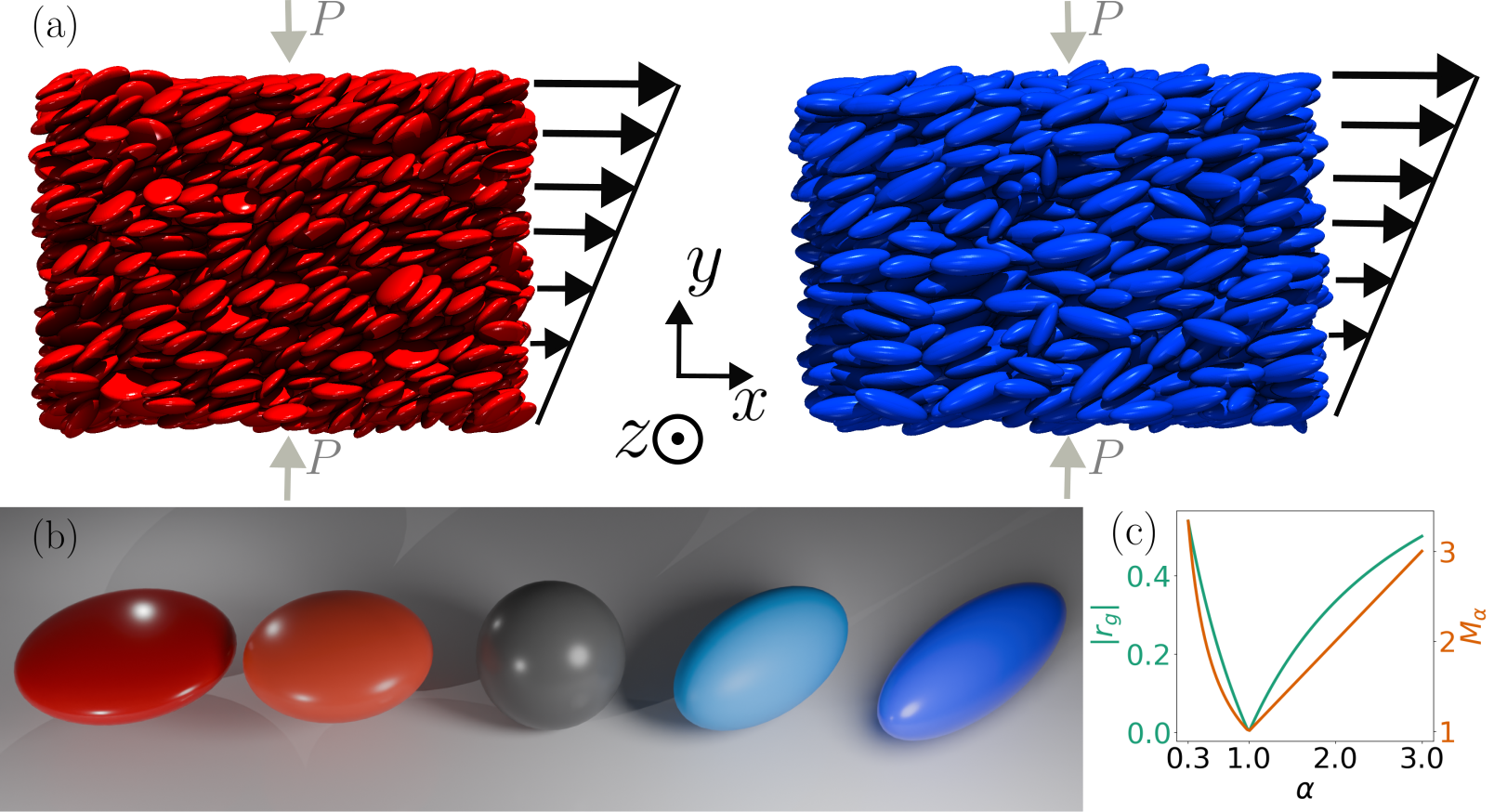
Abstract: The rheology of dense granular shear flows is influenced by friction and particle shape. We investigate numerically the impact of non-spherical particle geometries under shear on packing fraction, stress ratios, velocity fluctuations, force distribution, and dissipation mechanisms, for a wide range of inertial numbers, friction coefficients and aspect ratios. We obtain a regime diagram for the dissipation which shows that lentil-like (oblate) particles exhibit an extended sliding regime compared to rice-like (prolate) particles with the same degree of eccentricity. Additionally, we identify non-monotonic behaviour of slightly aspherical particles at low friction, linking it to their higher fluctuating rotational kinetic energy… [shortened for brevity]
| Paper PDF | Code | Data |
Numerical study of simple shear dense granular flow of frictional elongated and flattened particles (2025)
Powder & Grains 2025, conference Proceedings
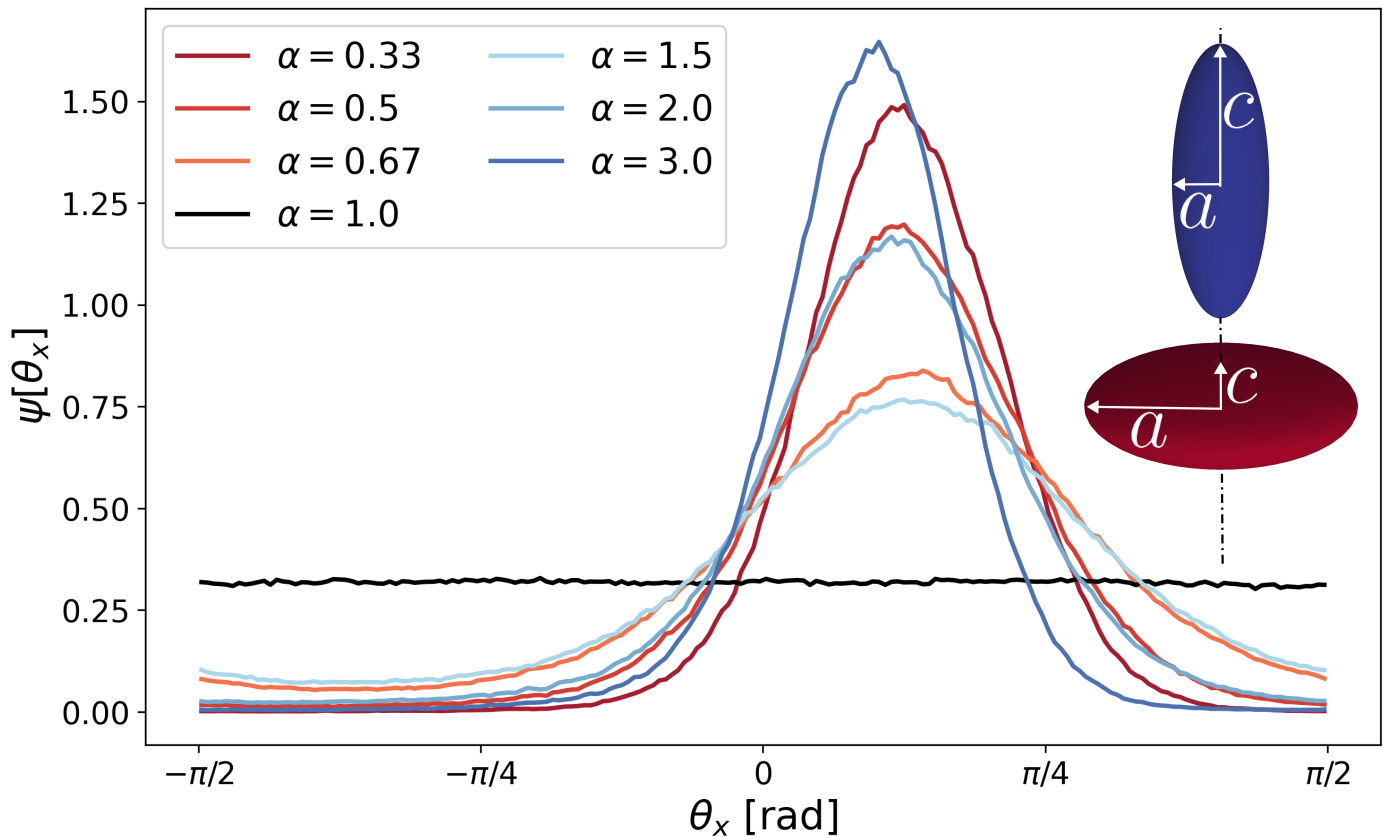
Abstract: Non-spherical particles play a crucial role in industrial and geological flows, however, a comprehensive description of their rheology as a function of inertial number and asphericity remains incomplete. In this study, we examine the influence of particle shape using spheroidal particles through simulations of simple shear flow under Lees-Edwards boundary conditions, focusing on the dense flow regime at constant applied pressure. Highly flattened, i.e. oblate lentil-like, particles manifest significantly fewer contacts and lower volume fraction, compared to elongated i.e. prolate rice-like, ones with the same shape ratio. The effective friction shows a non-monotonic dependence on the aspect ratio, and slightly flattened spheroids display a negative first normal stress difference. Furthermore, non-spherical particles tend to align their major axis with the flow, and energy dissipation becomes localized along this direction. As asphericity increases, tangential forces contribute increasingly to the overall shear stress.
Fluid-mediated Impact of Soft Solids (2024)
Journal of Fluid Mechanics, Vol. 997, A35
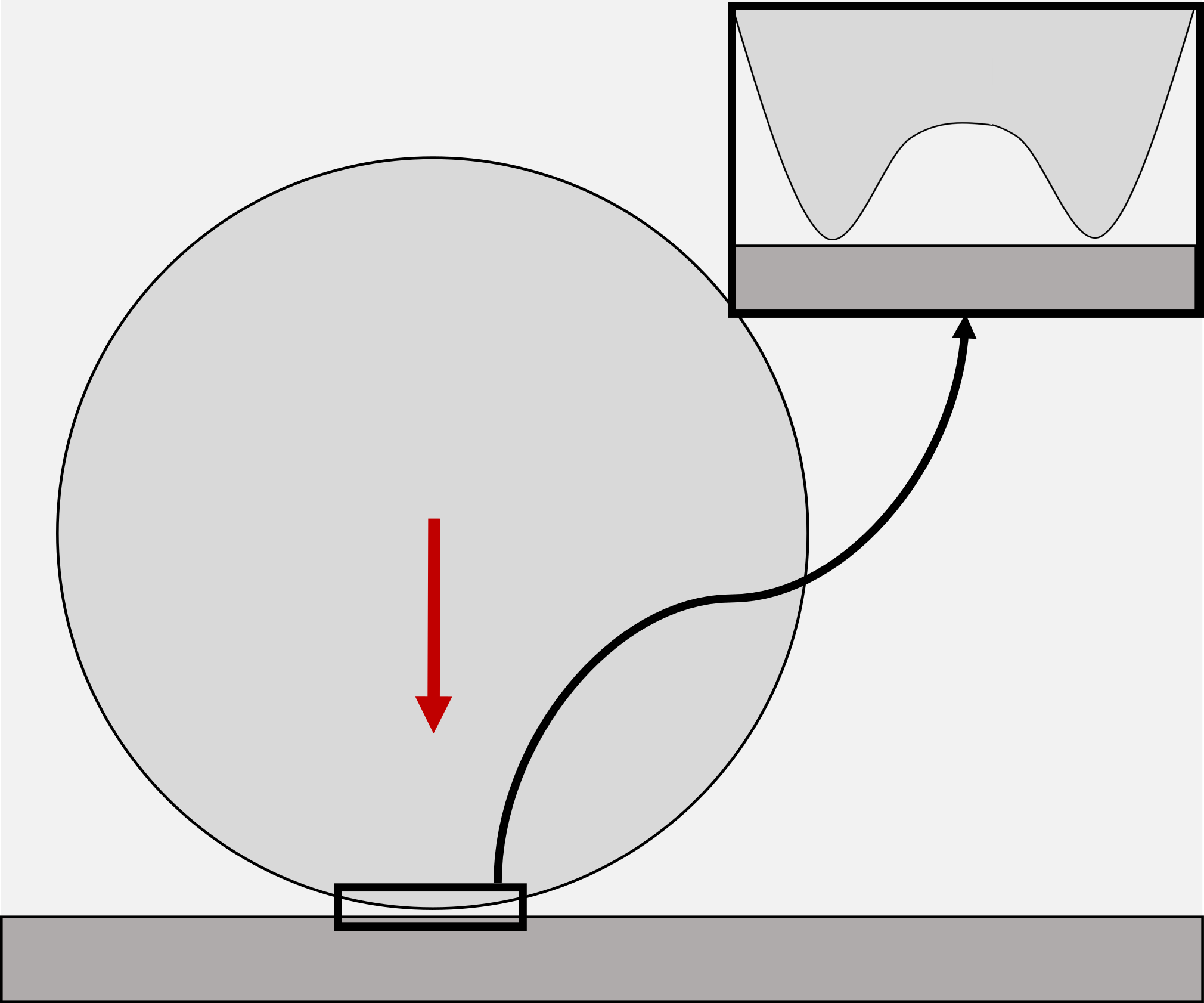
Abstract: A viscous, lubrication-like response can be triggered in a thin film of fluid squeezed between a rigid flat surface and the tip of an incoming projectile. We develop a scaling for this viscous approach stage of fluid-mediated normal impact, applicable to soft impactors. Under the assumption of mediating fluid being incompressible, the impacting solid displays two limit regimes: one dominated by elasticity, and the other by inertia. The transition between the two is predicted by a dimensionless parameter, which can be interpreted as the ratio between two time scales that are the time that it takes for the surface waves to warn the leading edge of the impactor of the forthcoming impact, and the characteristic duration of the final viscous phase of the approach. Additionally, we elucidate why nearly incompressible solids feature (a) substantial ‘gliding’ prior to contact … [shortened for brevity]
| Paper PDF | Code |
Industrial Collaborations
Surrogate model for process optimization (2022)
Bühler AG
Used DEM simulations and surrogate models based on gaussian processes to match machine operating conditions experimental data and optimize operational parameter choice
Coating Failure Modelling (2022)
Master Thesis, Sapienza University/ASML Holding
Combination of advanced FEM simulations, nano indentation cleanroom experiments and reduce order modeling to understand and design wafer clamp coatings for the semiconductor industry